SCR DC Motor Drive
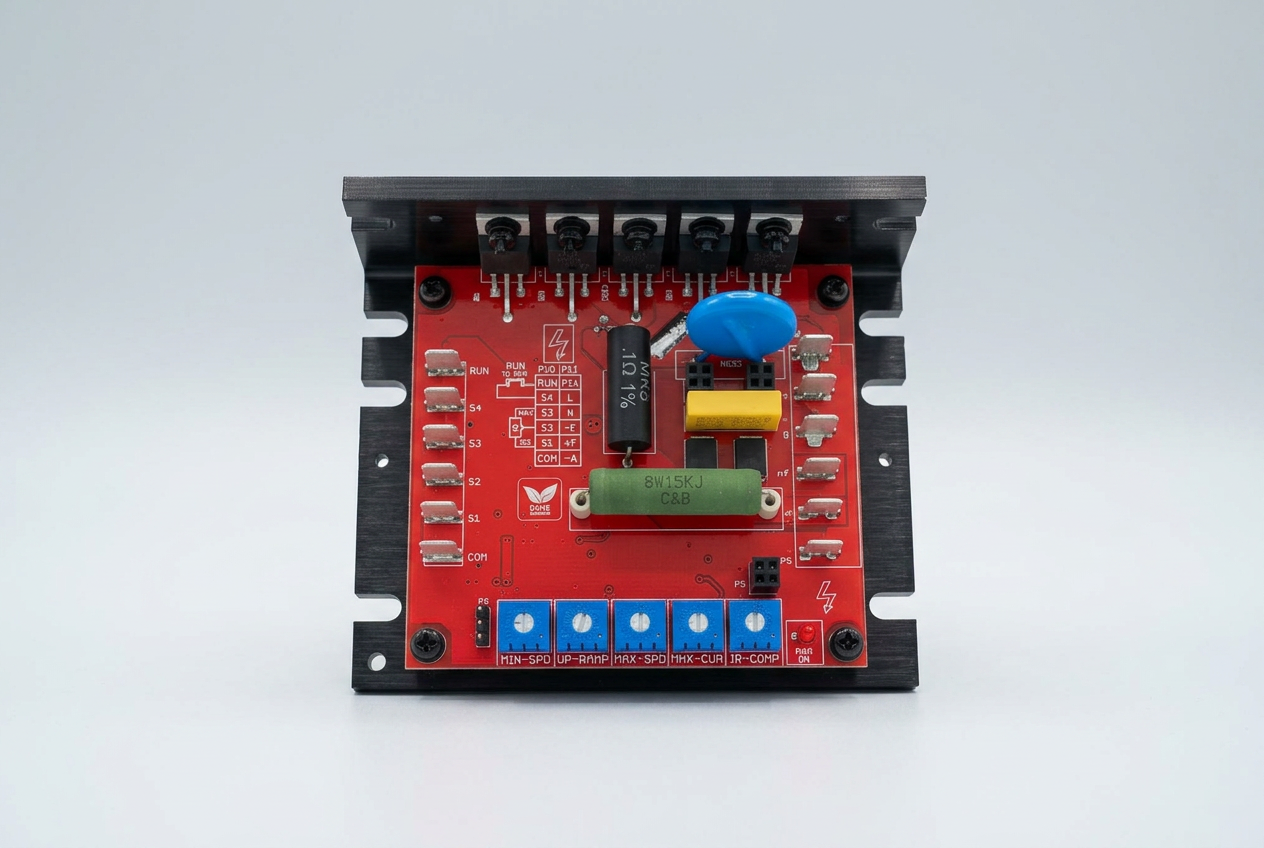
What is an SCR DC Motor Drive
An SCR DC motor drive is a power-electronic controller that converts a single- or three-phase AC supply into an adjustable DC armature voltage to drive a brushed or shunt-wound industrial DC motor. The “SCR” in the name refers to the silicon-controlled rectifier — also called a thyristor — the high-power semiconductor switch that does the rectification and the speed control in a single stage.
For decades, SCR-based controllers have been the backbone of industrial motor control for 90 V and 180 V DC motors fed directly from 115/230 VAC single-phase mains and from 230/460 VAC three-phase mains. They remain the most cost-effective and rugged way to deliver AC to DC motor control at industrial power levels, and they continue to be specified for new builds as well as for retrofits of legacy DC machinery.
Ameronics manufactures a complete family of SCR DC motor drives — RedVolt, Voltix, Regencore 4Q, and Revoxa 4Q — alongside our low-voltage PWM DC motor controller line and our four-quadrant regenerative DC drives. Together they make up our full range of DC motor drive controllers, so the right topology can be specified for the supply, motor, and duty without compromise.
How SCR Motor Control Works
SCR (thyristor) control in plain language
Think of each SCR as a high-power switch that the drive can turn on at any chosen point during its half-cycle of the AC waveform, and that then turns itself offautomatically at the next zero crossing. By choosing when to turn each SCR on, the controller decides how much of each half-cycle’s voltage is passed through to the motor — and therefore the average DC voltage at the armature terminals.
Phase angle control
The exact moment each SCR is fired, measured from the AC zero-crossing, is called the firing angle or phase angle. Firing early (a small phase angle) lets most of the half-cycle reach the motor and produces a high average DC voltage. Firing late (a large phase angle) lets only the tail of the half-cycle through and produces a low average DC voltage. By smoothly sweeping the firing angle from full retard to full advance, the drive delivers stepless DC motor speed control from creep speed to full base speed without contactors or gear changes.
Voltage regulation and closed-loop control
How SCR control compares to PWM
Unlike a PWM DC motor controller, which switches a low-voltage DC bus on and off thousands of times per second, an SCR drive operates at line frequency (50/60 Hz) and rectifies AC mains directly. There is no intermediate DC bus, no high-frequency switching, and no need for an isolation transformer in most installations. That makes SCR drives mechanically simple, electrically rugged, and well-suited to the high voltages and currents of industrial 90/180 V DC motors — exactly where PWM topologies become less attractive due to switch ratings, EMI, and thermal cost.
Request a quote for SCR drives sized to your motor and supply
Tell us your AC supply, motor voltage, current, and duty — we'll match a RedVolt, Voltix, Regencore, or Revoxa model and reply within one business day.
Key Features and Benefits
Applications of SCR DC Motor Drives
Conveyor systems
Variable-speed control of belt, roller, and chain conveyors driven by 90/180 V shunt-wound DC motors — smooth ramping protects product, belts, and gear reducers, and tight regulation maintains line speed under load.
Packaging lines
Indexing tables, fillers, cappers, labelers, and film unwinds where speed accuracy and torque holding directly affect throughput, weight accuracy, and reject rates on high-speed packaging equipment.
Industrial machinery
Mixers, extruders, grinders, machine tools, web tensioners, pumps, and fans in plastics, food, paper, metals, and process industries — all classic applications for SCR DC motor drives in the 1/8–3 HP range.
Retrofitting older DC systems
When a 1980s- or 1990s-vintage DC drive fails and the underlying DC motor is still good, an Ameronics SCR drive is a drop-in replacement that restores production without the cost of converting the machine to AC vector control.
SCR vs PWM DC Motor Controllers
| Aspect | SCR DC Motor Drive | PWM DC Motor Controller |
|---|---|---|
| Supply | 115/230 VAC single-phase, 230/460 VAC three-phase | 12 – 90 VDC (battery / rectified bus) |
| Motor voltage | 90 VDC or 180 VDC armature | 12 / 24 / 36 / 48 / 72 / 90 VDC |
| Power range | 1/8 HP to 3 HP | Fractional to mid-HP |
| Switching | Line-frequency phase control (50/60 Hz) | High-frequency MOSFET/IGBT (10–30 kHz) |
| Best for | AC-fed industrial machinery, retrofits | Battery / mobile / low-voltage automation |
For a deeper look at the low-voltage side, see our PWM DC motor controller page; for braking-energy recovery applications, see our regenerative DC drives.
Why Choose Ameronics SCR Drives
Frequently Asked Questions
What is an SCR DC motor drive?
An SCR DC motor drive is a power-electronic controller that converts a single- or three-phase AC supply into an adjustable DC armature voltage to drive a brushed or shunt-wound industrial DC motor. It uses silicon-controlled rectifiers (SCRs, also called thyristors) configured as a half- or full-wave phase-controlled bridge. By delaying when each SCR is gated on within the AC half-cycle — the firing angle — the drive sets the average DC voltage delivered to the motor, providing precise DC motor speed control directly from the AC line without an intermediate DC bus.
How does SCR control motor speed?
Motor speed in a brushed or shunt-wound DC motor is approximately proportional to the average armature voltage. An SCR DC motor drive controls that voltage by varying the firing angle (phase angle) at which each thyristor conducts during its half-cycle of the AC waveform. Firing the SCRs early in the half-cycle delivers a higher average DC voltage and faster motor speed; firing them later in the half-cycle delivers a lower average voltage and slower speed. A closed-loop regulator compares the speed reference against an armature-voltage or tachometer feedback signal and continuously trims the firing angle to hold the commanded speed under load.
SCR vs PWM motor control — which should I use?
Use an SCR DC motor drive when you are powering a 90 V or 180 V industrial DC motor directly from 115/230 VAC single-phase or 230/460 VAC three-phase mains — the technology is rugged, simple, and proven from fractional horsepower up to several hundred horsepower. Use a PWM DC motor controller when your motor is a low-voltage (12–90 V) brushed or permanent-magnet motor running from a battery, rectified low-voltage supply, or DC bus, where high switching efficiency matters. Ameronics manufactures both topologies so the drive can be matched to the supply and motor.
Are SCR drives still used in industry?
Yes — SCR DC motor drives remain widely used across industrial motor control applications. Decades of installed brushed and shunt-wound DC motors in conveyors, mixers, extruders, machine tools, paper, plastics, and metals processing equipment continue to be controlled and serviced with SCR drives. SCR technology is also a cost-effective and easily serviceable retrofit when an older drive fails, because it directly replaces the AC-to-DC motor control function without requiring the customer to replace the existing DC motor or rewire the machine.
What voltage and horsepower do SCR drives support?
Ameronics SCR DC motor drives operate from 115 VAC or 230 VAC single-phase and produce a controlled 90 VDC or 180 VDC armature output. The RedVolt and Voltix families cover 1.5–15 A (1/8 to 3 HP), while the Regencore 4Q and Revoxa 4Q regenerative families cover 5–10 A for four-quadrant duty with braking energy recovery. Larger custom builds are available on request.
Related drive families
Speak with an engineer about your SCR DC motor drive
DC motor drive controllers and custom power electronics engineered for the most demanding industrial environments. Proudly designed and manufactured in the USA.